
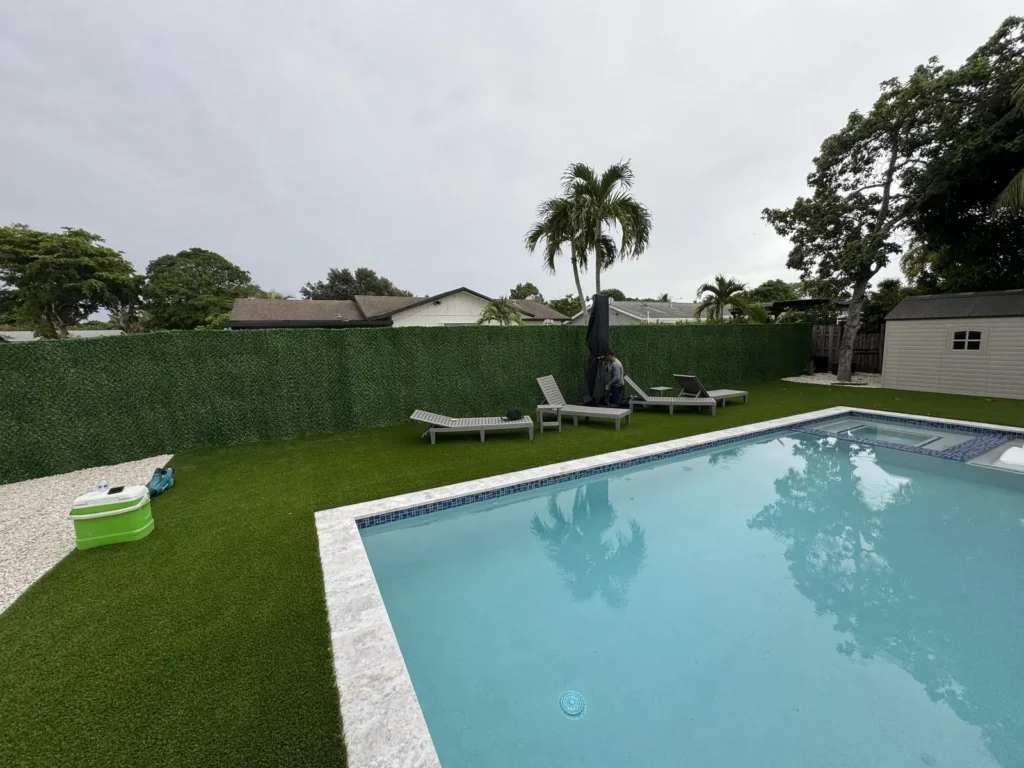
Aluminum fences are the go-to pool fence in South Florida. They do not rust like steel, they stand up to sun and rain, and the open picket design keeps the pool area safe without feeling closed in. The trade-off is privacy. Neighbors on a second floor, people walking by and anyone on the other side of the canal can see your whole pool deck.
You can add privacy to an aluminum fence without replacing it. The catch with a pool fence is that it is often doing a second job as your pool barrier, and Florida has rules for those. Here is how to get a green, private pool area and keep the barrier doing its job.
First, know whether your fence is the pool barrier
Many aluminum fences in Florida backyards are not just decoration. If the fence surrounds the pool and was inspected when the pool was permitted, it is likely part of the required pool barrier. Florida’s Residential Swimming Pool Safety Act (Chapter 515, Florida Statutes) and the Florida Building Code set out what a residential pool barrier needs. The main points:
- Height. At least 4 feet (48 inches) tall, measured on the outside, away from the pool.
- Nothing to climb, crawl under or squeeze through. No gaps, openings, indentations, protrusions or structural parts that would let a young child get over, under or through.
- Little clearance at the bottom. Miami-Dade’s guidance on the Florida Building Code lists a maximum of 2 inches between the ground and the bottom of the barrier.
- Self-closing, self-latching gates. Pool gates open outward, away from the pool, and close and latch on their own, with the release out of a young child’s reach.
- No climbing aids nearby. Equipment, planters or permanent structures cannot sit where they would help someone climb over.
If your aluminum fence is only a property-line fence and a separate barrier (such as a screen enclosure) protects the pool, you have more freedom. If you are not sure, assume the fence is the barrier until your building department tells you otherwise.
Why grass fence rolls work on aluminum fences
Grass fence rolls attach to the fence you already have. There are no new posts and no new structure. That is why covering an existing fence generally does not require a new fence permit, although you should confirm with your city and get HOA approval if you have an HOA.
- Full privacy from day one. A dense green wall instead of waiting years for a hedge to grow in.
- Made for pool areas. UV-protected PVC blades on a galvanized steel wire core that resists rust and salt air. The rolls are waterproof and drain right away, so splashes and afternoon storms are not a problem.
- Flame-resistant material.
- No watering, trimming or leaf cleanup in the pool, which is a real advantage over a planted hedge next to the water.
Keep the pool barrier working
A covering should never make the barrier easier to get past. Before and during installation, keep these points in mind:
- Talk to your building department first. Pool barriers are inspected as part of the pool permit, and rules differ by city and county. Ask whether adding a decorative covering to your pool fence is allowed at your address and whether they have any conditions.
- Do not create footholds. Ties, seams and edges should be tight and flush. Avoid anything that sticks out or sags in a way a child could step on or grab.
- Keep the height and bottom gap. The covering should not lower the effective height of the barrier, and the fence’s bottom clearance should not change.
- Leave the gates alone, or cover them carefully. A gate must still swing freely, close by itself and latch every time. Extra weight or a roll edge rubbing the post can stop a gate from latching. Test the gate several times after installation.
- Never cover or block the latch. The release needs to work exactly as before.
- Do not use the fence for climbing aids. Do not add planters, benches or shelves against the fence as part of the makeover.
When in doubt, ask the inspector. A short call before the project is much easier than redoing it later.
Plan your rolls
Most aluminum pool fences are 4 feet tall, with some taller sections. Dolce Green rolls come in three sizes:
| Roll size | Coverage | Good for |
|---|---|---|
| 4 ft × 32 ft | 128 sq ft | Standard 4 ft pool fences |
| 6 ft × 32 ft | 192 sq ft | Taller 6 ft aluminum or property-line fences |
| 6 ft × 8 ft | 48 sq ft | Short runs, gates and finishing sections on 6 ft fences |
Example: a 4 ft aluminum fence with 70 ft of run needs three 4 × 32 ft rolls (96 ft), with the extra trimmed off or used on another section. Measure each side separately and mark gates and corners.
How the installation works
- Check the fence. Tighten loose pickets and make sure posts are solid. The covering is only as straight as the fence.
- Attach along the top rail first. Use UV-resistant heavy-duty zip ties, then tie along the middle and bottom rails and to the pickets in between.
- Butt the seams tightly so there is no visible gap between rolls, and tie both edges.
- Trim cleanly around posts and gate hardware with a sharp utility knife, and snip the zip-tie tails.
- Test every gate before you call the job done.
Our iron and aluminum fence page shows how the finished look compares on these fence styles.
South Florida tips
- Wind. A covered fence catches more wind than an open picket fence. Make sure posts are solid before hurricane season and walk the fence after a big storm. Our guide to hurricane season and grass fence rolls covers how to prepare.
- HOA approval. Many communities want to see the product and color before you install. Read our guide to HOA rules for privacy fences in Miami-Dade and Broward.
- Chain-link pool fences follow the same barrier rules. See how to cover a chain-link fence for privacy.
DIY or professional installation?
A straight run of aluminum fence is a manageable project for a handy homeowner. Pool fences with several gates, corners and slopes take more care, especially because the gates have to keep closing and latching properly. Dolce Green crews install in Miami-Dade, Broward, Palm Beach, Monroe and Lee counties, with free delivery in Miami-Dade and Broward. For more ideas, visit our pool fences page, or request a free quote and we will look at your fence with you.
Sources
- Florida Statutes, Section 515.29: Residential swimming pool barrier requirements
- Miami-Dade County: Pool Barriers (Florida Building Code overview)
Ready for a greener, more private space?
Tell us the length and height of your fence or wall and we will send you a free estimate for rolls or installation.