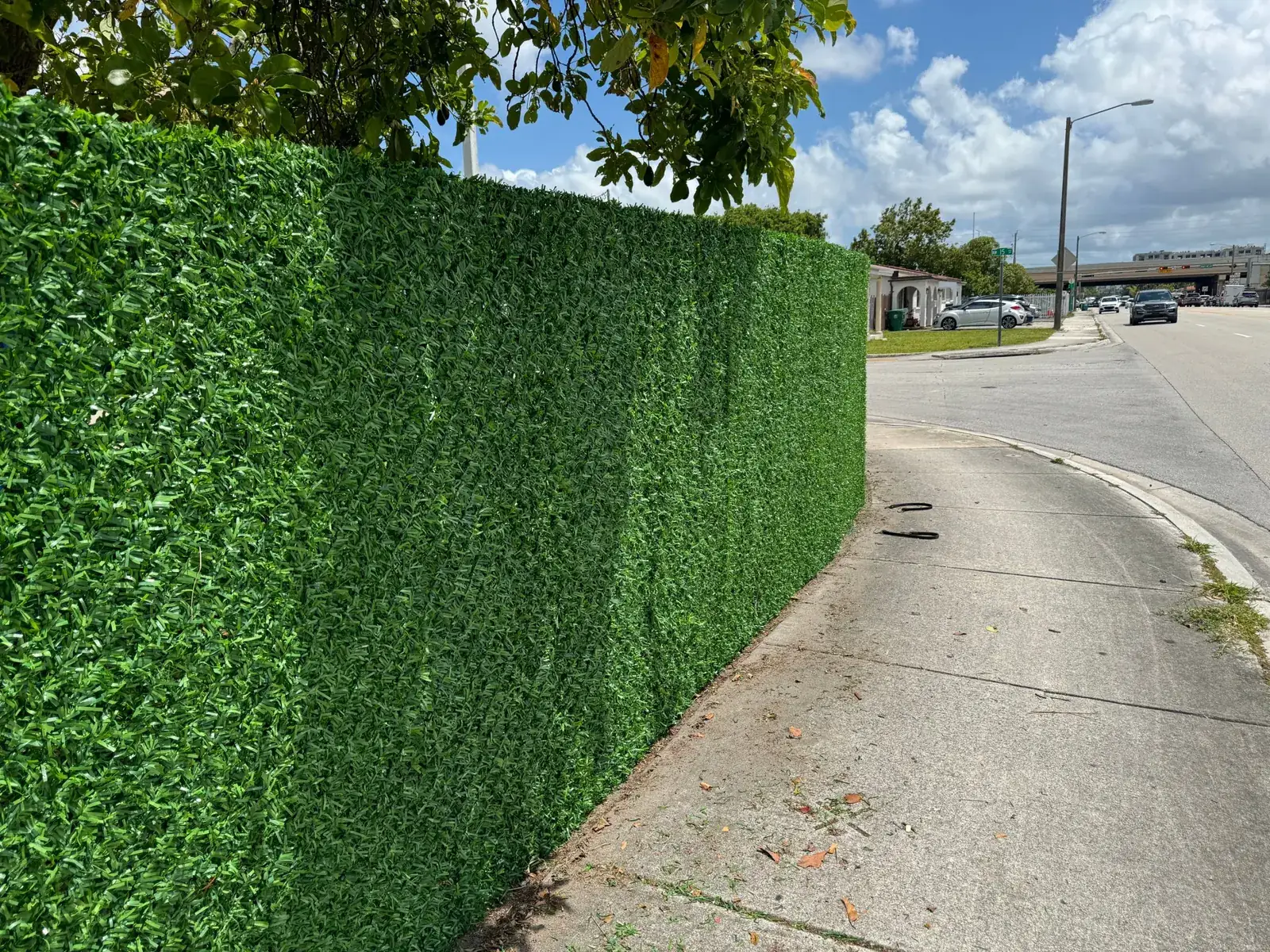
Walk through almost any neighborhood from Homestead to Jupiter and you will see the classic South Florida privacy solution: a tall green hedge. For decades that meant ficus. Today many homeowners plant clusia instead, and a growing number skip the plants entirely and cover an existing fence or wall with an artificial hedge.
Each option can give you a green, private yard. They differ a lot in how long you wait, how much work they take and what can go wrong. Here is an honest comparison for South Florida properties.
The real hedge options: ficus and clusia
Ficus (usually Ficus benjamina) was the default privacy hedge for years because it fills in densely and takes heavy trimming. Its weak point arrived in 2007, when the ficus whitefly was found in South Florida. According to UF/IFAS, without control this pest can cause severe leaf drop, and in some cases branch dieback and plant death. Many Miami-Dade homeowners watched their privacy hedges lose their leaves, and the pest still has to be managed today.
Clusia became the popular replacement. It has thick, leathery leaves and handles our heat well. Florida’s native pitch apple (Clusia rosea) is rated by UF/IFAS as highly tolerant of salt spray and largely free of serious pests, which makes it a good fit near the coast. Keep in mind it is a tree by nature: UF/IFAS lists a mature height of 25 to 30 feet, so it needs regular trimming to stay a hedge, and it has a vigorous root system. Small-leaf clusia varieties sold at nurseries are also common; ask your nursery about the variety’s size and care needs.
The artificial option: a hedge on the fence you already have
An artificial hedge from Dolce Green is a grass fence roll that attaches to an existing fence or wall. The blades are UV-protected PVC on a galvanized steel wire core that resists rust and salt air. The rolls are waterproof, drain right away and are flame-resistant. There is nothing to water, trim, fertilize or spray.
Because it is a decorative product that attaches to a fence you already have, covering an existing fence generally does not require a new fence permit. Confirm with your city, and check with your HOA, since many associations want to approve the product and color first. Our guide to HOA rules for privacy fences in Miami-Dade and Broward explains what boards usually look for.
Side-by-side comparison
| Real hedge (ficus or clusia) | Dolce Green artificial hedge | |
|---|---|---|
| Time to full privacy | Depends on plant size; small plants can take years to fill in | Same day it is installed |
| Needs a fence or wall? | No, it grows on its own | Yes, it attaches to an existing fence or wall |
| Watering | Needed, especially while getting established | None |
| Trimming | Regular, often several times a year | None |
| Pests | Ficus whitefly, scale and others | None |
| Space used | A planting bed several feet deep, plus roots | Only the thickness of the fence and the blades |
| Looks after storms | Can lose leaves or branches and need recovery time | Inspect and re-tie if needed |
Cost: think beyond day one
Comparing a hedge and an artificial hedge only on the purchase price misses most of the picture. With a real hedge, the plants are only the start. Over the years you also pay for:
- Irrigation and the water it uses. South Florida also has landscape watering rules that limit when you can run sprinklers, and they can tighten during dry spells.
- Trimming, either your weekends or a landscaper’s monthly bill.
- Pest treatments, especially for ficus.
- Replacement plants when sections die out or thin after pests or storms.
- Cleanup of leaves and clippings, including from pools and gutters.
An artificial hedge costs more up front than a row of small nursery plants, but the ongoing costs are close to zero. The bigger the hedge and the longer you plan to stay, the more that matters. Every property is different, so the best way to compare is to get a quote for your fence and price out the hedge you would otherwise plant.
When a real hedge still makes sense
We sell artificial hedges, but a planted hedge is the better choice in some situations:
- There is no fence or wall to attach to, and you do not want to build one.
- You want habitat for birds and pollinators. Native plants support local wildlife in a way no artificial product can.
- You need privacy higher than your fence. A hedge can grow well above 6 feet, while a grass fence roll covers the fence it is attached to.
- You enjoy gardening and do not mind the upkeep.
Some homeowners do both: an artificial hedge on the fence for instant, low-maintenance privacy, with a few native shrubs in front for depth and wildlife.
When an artificial hedge is the better fit
- You need privacy now, for example after moving in, after a ficus hedge died back or when a new neighbor builds a second story.
- The space is narrow, like a side yard, a pool deck next to the fence or a zero-lot-line home where a planting bed does not fit.
- Leaves and roots are a problem, such as next to a pool, a driveway or a block wall.
- You are a seasonal resident and cannot keep up with watering and trimming while you are away.
- Coastal properties where salt air is hard on many plants. The galvanized wire core is made to resist rust and salt air.
Choosing roll sizes
Dolce Green rolls come in three sizes, so you can match most South Florida fences:
| Roll size | Coverage | Good for |
|---|---|---|
| 4 ft × 32 ft | 128 sq ft | 4 ft chain-link, aluminum and pool fences |
| 6 ft × 32 ft | 192 sq ft | Standard 6 ft wood, chain-link or block walls |
| 6 ft × 8 ft | 48 sq ft | Short runs, gates and finishing sections |
If you are replacing a dying ficus hedge that grew in front of a chain-link fence, see how to cover a chain-link fence for privacy. For a pool fence, read our guide to covering an aluminum pool fence in Florida first, because pool barrier rules apply.
Good to know before you decide
- Rules differ by city and HOA. Some communities have rules on hedge height and upkeep, and many HOAs review fence coverings. Check with your city or county and your association before you plant or install.
- Hurricane season. A covered fence catches more wind, so make sure posts are solid. Our hurricane season guide covers what to check.
- Warranty. Rolls purchased and installed by Dolce Green carry a 3-year limited warranty. Sun fading is not covered.
The bottom line
A real hedge is a living plant that takes time, water, trimming and pest control, and rewards you with something natural. An artificial hedge gives you the same green look the day it goes up, with almost no upkeep, as long as you have a fence or wall to attach it to. For many busy South Florida households, especially those who have already lost a ficus hedge, that trade is an easy one.
See finished projects on our private hedges page and in the gallery. Dolce Green crews install in Miami-Dade, Broward, Palm Beach, Monroe and Lee counties, with free delivery in Miami-Dade and Broward. When you are ready, request a free quote and we will help you compare.
Sources
- UF/IFAS Extension: Ficus whitefly
- UF/IFAS Miami-Dade Extension: Do You Remember the Ficus Whitefly?
- UF/IFAS Extension: Clusia rosea, Pitch Apple
- UF/IFAS Miami-Dade Extension: Shrubs and Hedges
Ready for a greener, more private space?
Tell us the length and height of your fence or wall and we will send you a free estimate for rolls or installation.